Tuesday, October 22, 2013

Workshop 2

                  Try to picture it--- 15 high school students in a small room, excitedly fiddling with their new cameras; chatter, laughter, snapping photos. This is the image of the Peace in Focus Workshop #2—Introduction to Digital Storytelling. Our second workshop of the summer ran from July 8th through July 19th. Our all-star college students arrived on Day 1 of the workshop full of energy and ready to pass all their knowledge on to the high school students. The room was filled with dedicated youth, ready to work together as young leaders and change their community for the better.

                  Similarly to Workshop 1, we made our way through the Peace in Focus manual. Almost every day we took breaks, usually to go outside. Frequently we broke out into small groups and went on photo scavenger hunts around the neighborhood. Students responded very well to our activities. One of their favorite parts was re-grouping after small group photo time and viewing each other’s work. They were inspired and motivated by each other.

                  Many of the students indicated that one highlight of their experience was a series of debates that we had surrounding the question of photography used as a way to display the raw truth of conflict in the world, and photography as a way of exploiting poverty and war zones. I shot a great video of one of these debates, and will try my best to upload it here to the blog. If that doesn’t work, I will post a link to the video later. The debate truly split the room-- half the students advocated that photography can be a powerful tool to tell the world what’s happening in a given area, while the other half wholeheartedly believed that too often, photography is a tool of exploitation, and that photos of impoverished children and war-torn areas do not create effective change. Of course, there was no right answer, but it is a critical question to consider while pursuing a career in photography or photo journalism.
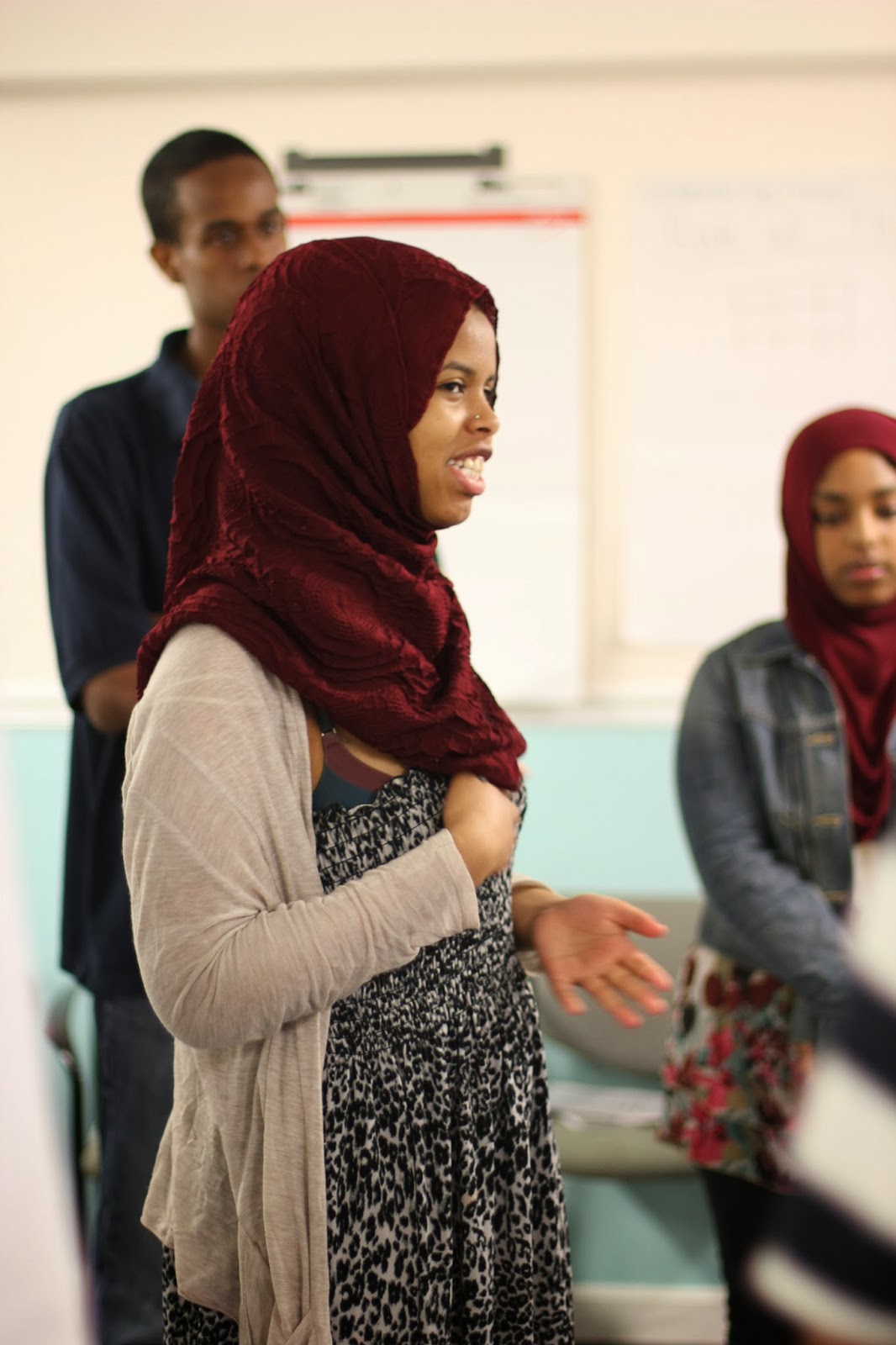

                  For us, it was incredibly rewarding to see our trained college students take strong leadership roles for Workshop 2. This was a pilot model for us, and we look forward to using it again in the future, and to teaching this model to other organizations. We are well aware that it is difficult to sustain small projects such as this, but perhaps this model is the key to continuing PIF work. We hope that next year, our trained PIF facilitators at ACEDONE will be able to continue this important work, and work with a new group of high school students in the Roxbury community. They are now equipped with the tools, experience, and passion to continue fueling the project!
To view all of our photos from Workshop 2, visit our Facebook

Saturday, September 21, 2013

Workshop 1


Wednesday, August 28, 2013

Summer 2013, Workshop 1: "The Training of Trainers"

                We’re thrilled to report that summer 2013 was incredibly eventful for Peace in Focus. We partnered with ACEDONE (African Community Economic Development of New England) for the third summer in a row.  We started off with a two-week workshop called the “training of trainers.” Our goal for this workshop was to train 5 college students in digital storytelling facilitation. Thus, by the end of the training, all five would be Peace in Focus facilitators, enabling them to help us lead a second workshop for high school students. The first workshop took place from June 3rd and ran through June 14th. We worked with amazing young people who are not only passionate about their busy college lives, but also about becoming leaders in their community of Somali immigrants and refugees.

                Our workshop started with the students brainstorming about their goals and expectations. 

In this way, we all held each other accountable to our group rules, expectations, and goals. We moved quickly through the Peace in Focus training manual, in which there were three modules. Activities in these modules include story of self, self-lens, life plot, as well as composition tips, visual literacy, and the art of effective digital storytelling. In this way, our students simultaneously increased their knowledge of camera-use, while practicing digital storytelling. 

The students learned to photograph objects, locations, people and places in their neighborhoods that they wanted to change. Thus, the photography was used as a lens through which students looked and saw what they wished to change about their communities.

                All of our college students who participated in Workshop 1 have a strong connection to Somalia. Each of their parents came to the US from Somalia either by choice, or as a result of conflict within Somalia. We had numerous lively debates and conversations about how Somalia is portrayed in the news. We used Somalia as an example of how we can use photography as a catalyst for positive change in order to combat the media’s negative portrayal of both Somalia and Africa. “The Danger of a Single Story,” a TED Talk by Chimamanda Adichie sparked even more debate about the story of Somalia. By the end of our workshop, the students came to the conclusion that educating others through digital storytelling truly could have a positive result, and slowly we can work together to change the narrative of Somalia and Africa.

                The overarching goal of the “training of trainers” was to enable our students to become PIF facilitators. We successfully accomplished this, and our incredible college students were ready to take on the 15-20 high school students during Workshop 2!


                To see some of our students’ bios, as well as more photos from Workshop 1, please click this link to our Facebook album from Workshop 1.

Friday, July 6, 2012

Stereotypes Facing Africans


Stereotypes are problems that Africans face a lot. For example Somali people have been identified as pirates and terrorists but they are not. Africa is identified as a very poor continent even though Africa is very rich in culture and natural resourses. Africans are identified as illeterate, not brave and often seen as one, but in reality the continent is extremely diverse, and some countries in Africa even have their own writing system as for example Ethiopians do. Ethiopians and Somalis have defeated Italians when they were trying to colonize them, which shows that they are brave. Africa is also viewed as a very uncivilized place which is filled by jungle and Africans live in the jungle running around naked, but in reality most of Africa is urban and most Africans lead an urban life and wear clothes.


Challenges Immigrants Face


When immigrants first come to a new country they go through a lot of problems and hit a brick wall. Immigrants face problems economically, socially and they face some type of discrimination. Immigrants usually feel isolated and different but if they understand the fact that they are in the USA now and they are part America and they should still retain their culture. Moreover, if immigrants have community people and organizations by their side they are more likely to succeed and improve both economically and socially. On the other hand, immigrants almost always need help finding jobs and a good education and that’s usually what organizations are there for. For example, there is an organization in the Boston area called ACEDONE and it mainly focuses on youth’s education but always helps adults find jobs. They helped hundreds of new immigrants get a job and apply for social security, food stamps and other helping programs from the government. On the other hand, there is another organization SDC that helps African communities especially Somalis with any legal problems with the government such as jury duty, housing hearings and any problems with the law.


Tuesday, June 12, 2012

Who We Are...


Since we ask our students to describe themselves through words and images, we thought we should share who we are...

Joel, our Program Coordinator describes his work with Peace in Focus & gives you a tour of our space:


Friday, June 1, 2012

Who We Are...


Since we ask our students to describe themselves through words and images, we thought we should share who we are...


Renee, our Communications Coordinator describes her work with Peace in Focus:


Wednesday, May 30, 2012

"I AM" Photography Exhibit was a success!

Thank you to everyone (especially Youth In Action Somalia) who came out and supported our recent photography exhibit at United South End Settlements! The event featured artwork by youth in the US, Africa, and Caribbean.  Inspiring youth participants from our Boston programs talked about their inspirations and experiences. 

We are excited to continue bringing great programs this summer. Look for our photography exhibit opening in the gallery space in Boston City Hall this July and more workshops coming up in Boston and Mexico this summer!

Check out these photos from the "I AM" Photography Exhibit: 


Thursday, May 17, 2012

Small Shelter


Thank you for sending us your photos for our "Homecoming" Photo Contest!
Check out this photo taken by Tatevik, a 23 year old from Yerevan Armenia:


This photo shows my room. My small, old room, which I designed with different posters, funny and cute stuff. I love and miss my small shelter where I spend all my life every time I leave.  

Tuesday, May 15, 2012

Who We Are...

Since we ask our students to describe themselves through words and images, we thought we should share who we are...

Jonas, our Curriculum Development Coordinator describes his work with Peace in Focus:


Thursday, May 10, 2012

I Am: An Exploration of Identity Community and Homecoming


Peace in Focus Photo Exhibit
I Am: An Exploration of Identity Community and Homecoming
May 23, 2012 from 6-8pm
United South End Settlements


Wednesday, May 2, 2012

PROSPERITY CANDLE is the perfect gift for Mother's Day!


“Mothers are the light of the world. Every mother can give the light to her children and other people.” ~ Moo Kho, Burmese refugee candle-maker & Mom of 3 girls

Support a Mom like Moo Kho as she rebuilds her life this Mother's Day with a beautiful Prosperity Candle gift.

Prosperity Candle's Mother's Day gifts are gifts that truly give back, many times over. Each meaningful gift gives to a Mom in your life, while also enabling the who made it to earn above a living wage. And now, these gifts benefit our work as well! When you shop for a gift from Prosperity Candle, credit (Peace in Focus) at checkout under "How did you hear about us?", and 10% of your purchase will support our work.

Every candle is a vehicle for social change and global connection. You can connect with the woman who made your candle by finding her name on the label, looking up her bio, and sending her a message from the Prosperity Candle website. Consider making a connection between Moms around the world this Mother's Day, the way one woman, Lauren, did last year. Read more about her story here.

To start, take a look at their gift collection here. All orders of $75 or more include free shipping. Be sure to order by May 7th for prompt delivery and mention (Peace in Focus) to help us raise funds!

Thursday, April 19, 2012

Contemporary History of Roxbury

Roxbury is a historically rich architectual community in Boston. It has recently become diversified and it remains " the Heart of Black Culture in Boston." Roxbury is one of the first towns founded in Massachusetts Bay in 1630. In today's time Roxbury has many historical places that have been rebuilt and restored throughout the city.

John Eliot square was a strategic meeting point for soldiers during the Revolutionary War because its elevated Highland over Downtown Boston.
John Elliot was the most famous pastor of the First Church of Roxbury and was able to integrate Algonquin Indians to become full members of the Church.

First Church of Roxbury was buit in 1632 and was the first meetinghouse for soldiers in 1804 is the focal point of the neighborhood.

First Hotel of Roxbury that was crucial point desegregating Roxbury. Now it houses condominium and offices including the fairly new member of the complex African Community Economic Development of New England (ACEDONE).

In the bottom left corner of building resides a parting stone from the 1800s. This monument was a form of locational recognition. Now it remins hidden and unnoticed under a Foreign Car Auto Shop, despite being significant two centuries ago.

This is New Edition to the Roxbury community, Islamic Society of Boston Cultural Center, served as a new attraction to the people of Roxbury, has strengthened community ties, and has brought much diversity to the area.

- By Kaynan Yassin, Sagal Yassin, Endkle Getachew, Mohamud Hussein, and Nasir Abdullahi

A time to unite with peace

        The meaning of peace is to communicate with other  people with out any kind of violence  or other problems. These pictures below shows us how peace works in a variety ways and helps to discourage violence. One way to keep peace is by keeping social justice. 

Photographing Shakeem's Rest in Peace pin he wears to remeber his friend that was taken by violence in Boston.


Spread the love, Antonio (black) and Gio (white) converse about the violence in Boston that has taken the lives of young. Gio, 17 years of age, explains it has to stop because it stems from foolishness.

In support of Trayvon Martin black hoodies are worn by high school students in Boston. Trayvon Martin's death is an example of the disese we call violence in America. We need PEACE!

 Gio, 17 years old from Boston, feels that violence should cease ASAP in the streets in Boston and beyond. Gio was close friends of middle school student Taewon Martin who was shot and killed in Boston 2010.


Why so common? Shakeem wears a pin to remeber his friend middle school student Jaewon Martian who was killed in a Roxbury commuinty in Boston where the death amongst youth increases yearly.


created by: Antonio Stroud, Betsegaw Gillo,  Yabetse Gillo and Sahro Muse